



A CONVERSATION WITH DAVID WILLIAMS: The man who killed Art Oberto
By: David Speer – Unlimited News Journal
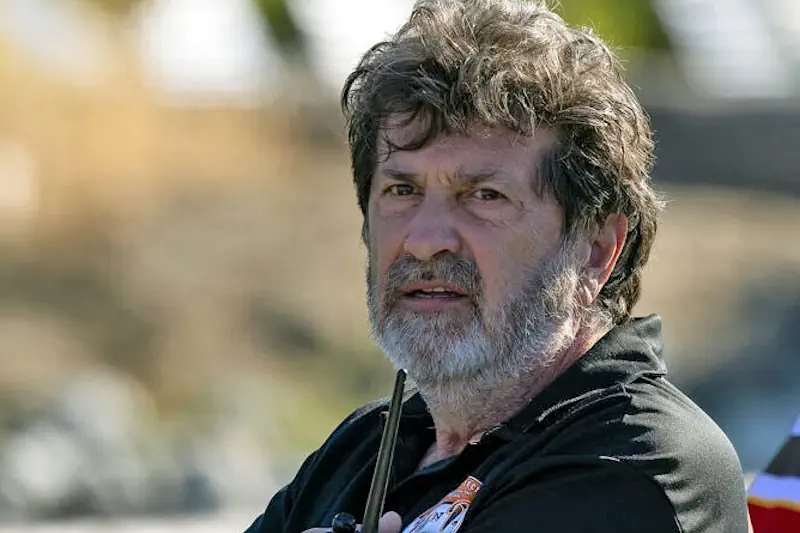
The following is an interview conducted by former Unlimited News Journal editor David Speer, who returns to the pages of the UNJ with this note: “David D. Williams recently retired after 32 years as executive director of Seattle’s Hydroplane and Raceboat Museum, which is routinely known as HARM. Similarly, after founding this monthly enthusiast newsletter—with scads of volunteer help, I covered Unlimited racing for 30 years via editorial and columnist roles with Boating, Powerboat, and Sea & Pacific Skipper magazines. From time to time, we two Davids crossed paths, of course, both carving professional lives from what began as hobbies. He’s 68, I’m 82. And now—without further ado—the two Davids lunched over pasta and caught up about HARM’s unique contribution to the sport. Thanks, David Speer.” The conversation between the two Davids has been edited for length and clarity.
SPEER: You’ve said your speedboat story is best told in three chapters.
WILLIAMS: The first chapter of growing up was going to school and dabbling with hydroplanes, followed by a pretty good 14-year career in the import-export business. Made some money, had some fun in Atlanta, New Orleans, Los Angeles, Seattle. The second chapter was seriously knocking about hydroplanes with people in the museum. Now I’m off into my third act, as a writer.
I can’t help but wonder if the legend of Bob Williams ties into this discussion in any shape or form.
Not really, by the time I came to the museum, he had been gone for a few years. Many people think Bob was my dad, but he wasn’t. However, by the late ‘80s, Bob was a big-time hydro fan and memorabilia collector, everything from pins to programs to buttons. Perhaps we know him best because he dared to dream the very big-time dream of a museum and hall of fame dedicated to Unlimited hydroplane racing.
As I recall, his enthusiasm seemed boundless if not endless. He had collected several hulls and maybe a zillion artifacts. Plans were drawn, potential building sites explored. Bob even negotiated the lease of an unused waterfront warehouse in the city of Tacoma, a site near today’s huge LeMay—America’s Car Museum. Bob’s consultants outlined a $12 million capital budget and projected 185,000 visitors a year. That’s 4,000 visitors a week!
Bob had a great idea, but he discovered that the depth of financial support in the hydroplane community wasn’t there. Despite significant promises of support, he didn’t get money from Budweiser, Miller, Circus Circus for instance. Letters are easy to write, checks are hard to write. “Seattle didn’t want it,” he said. It seems the opportunity to create the type of museum he envisioned had passed. That was 1990.
Let’s explore your own first encounter with a hydroplane.
I fell in love with these damn boats when I was five years old. We lived in Bothell, a Seattle suburb, but our family had property on Lake Coeur d’Alene. The first Unlimited race I actually saw was the ‘63 Diamond Cup—kind of a classic, with Mira Slovak’s explosive crash in Miss Exide and Bill Muncey’s third straight Diamond Cup but last win in Miss Thriftway.
I just fell in love with hydros the way some kids fall in love with football or baseball. That’s all I ever wanted to do. I pasted newspaper articles in scrapbooks and took pictures with my Brownie. The first photos were of the ‘64 Miss Bardahl because Ronnie Munson was short and dark, and I was short and dark. I was a very little kid becoming aware of the sport. Maybe in ‘65, my dad bought a copy of This Is Hydroplaning for my birthday. I saw there was more than one Bardahl. I was becoming a student of the sport.
The first Seattle race I saw was in ‘73—the race in the rain. Pay ‘n Pak and Miss Budweiser with Mickey Remund and Dean Chenoweth attacking the cold mist and each other in perhaps the alltime greatest deck-to-deck. Up to that point I’d only been to the Coeur d’Alene race. 1973 was a big year for me because I also went to Tri-Cities. So, this story comes from a fan’s perspective.
You found yourself standing outside the pit-area mesh fence, with your fingers clutching the wire.
Oh, absolutely. E.K. Muller was a good friend for both of us. One of the things he said that I’ll always remember: We love this sport because it’s the right size for us. It’s small enough for us to get involved and be part of, but still big enough to feel like it’s a big deal. Standing behind the fence, honestly, in my mind there was no difference between Ronnie Munson and Bart Starr as quarterback of the Green Bay Packers and John F. Kennedy as president and Johnny Carson the late-night TV star. All those people were the same in my mind. They were all heroes and all heroes were equal.
I’m smiling and nodding my head. We’ve heard this story before, told many ways over the years. Did you go to college?
I did. Like so many of us, I worked summer jobs, saved up for college, went to Washington State University. I was working on a journalism degree. At any rate, in ‘76 I went to Seattle’s Northgate Mall to do some Christmas shopping and the local inboard club had a display. There was a 145 cubic-incher built by Larry Campbell for sale: 2,500 bucks. Well, you know, I had saved $2,500 for tuition. I dropped out of college, bought that boat and rented a house by Green Lake so I could keep the boat in a garage. My parents were not happy.
Getting behind an Unlimited steering wheel had to have been your unspoken goal.
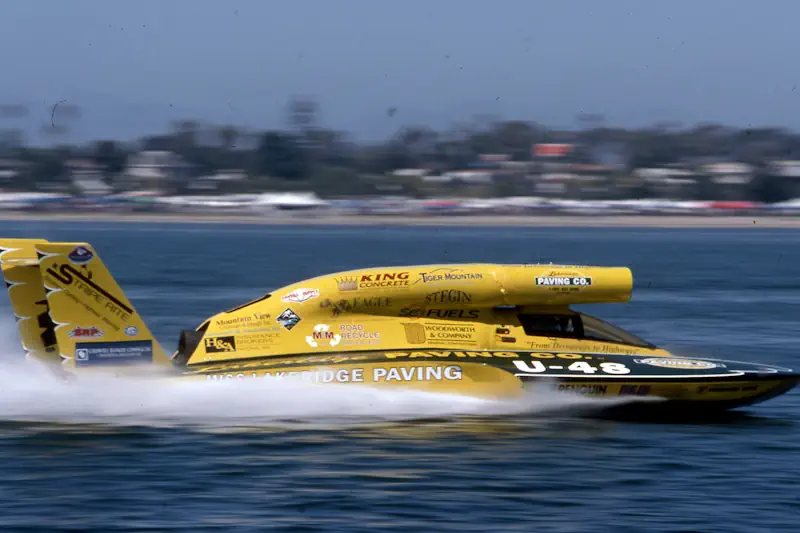
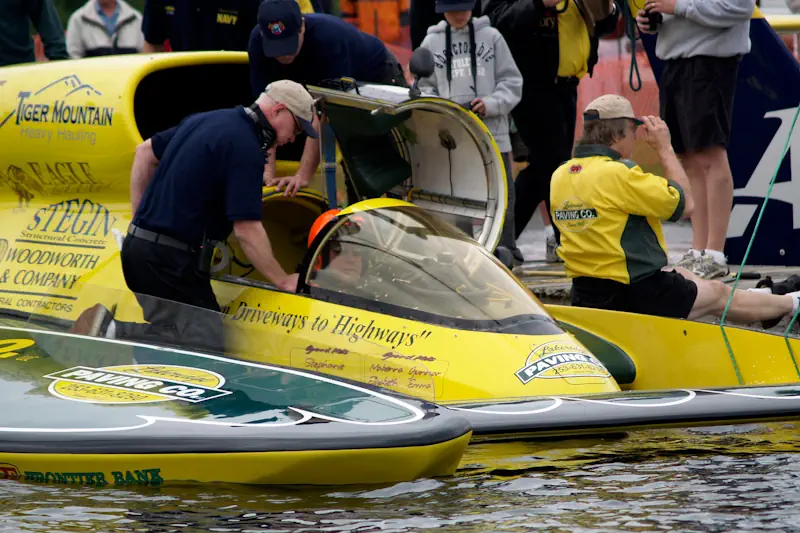
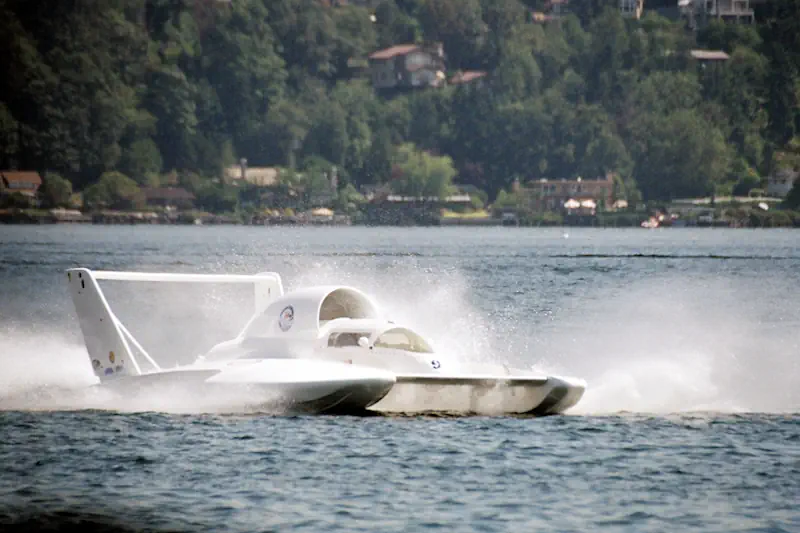
I drove a vintage Unlimited for the first time in ‘93. Since then, I’ve driven 18 vintage boats and six turbine boats, a total of 24 Unlimiteds. I’ve been able to take out Miss Thriftway that won that ‘63 Diamond Cup race. I drove the “Winged Wonder” Pay ‘n Pak. I was the first person to drive Atlas Van Lines after Bill Muncey’s fatal accident. Perhaps better yet, to restore that famous boat we put together a skilled group of volunteers. I mean, I don’t ever want to be seen as taking credit for their passion, their generosity, their work.
That’s the thing. We found a way to inspire our many volunteer craftspeople and staff. If my hydro story has any resonance, it’s that if you want something in our sport, just do it. There’s no “they” in our sport, it’s only “us.” There’s this big entity but it’s small enough we can personally have an impact. Along the way we’ve been able to bring this excitement to thousands of other people. I went from primarily being a fan to helping bring the icons of my childhood back to life. So much of what I’ve done here has been to recapture childhood golden memories.
All in all, today’s museum is certainly a huge comeback after Bob’s disappointment.
More than anyone, Ken Muscatel kept the possibility alive. You can’t think of a better guy to step in and try to ease Bob’s and his wife Shirley’s frustration. They had assembled a pretty good foundation. Ken had a deep enough pocket that he could keep things moving. He stored the museum stuff in a shop intended for his own antique collection, which included the truly classic Miss America VIII.
How did you get involved in Unlimited racing?
I was working in my front yard on my own limited, a big brown Cadillac drives by. The guy backs up and says, “Hey kid, you ever wanted to work on an Unlimited?” It was Bill Wurster. I lived two blocks from Bill and about 10 blocks from his shop in Ballard. The crew was heading to Miami, and I helped load the truck. I was sort of on cloud nine that I had touched an Unlimited.
Though I had dropped out of college, I was still thinking journalism. Later that year I had a job working for KYUS-TV in Miles City, Montana. It was the world’s smallest TV station but what a hoot! Five college kids rotating on camera, switchboard, writing, and reading news or sports. We all thought we were going to be famous. I wrote a letter to Jim Hendrick. Do you need a hydro fan helping with your radio broadcasts? He said “Sure, kid, meet me at the Gold Cup in Madison.” That was ‘79.
My good friend Fred Farley did not own a car, but I did. We decided to follow the circuit, and I spent Sundays working for Jim Hendrick as a technical assistant. I got paid a hundred bucks a broadcast, which sort of covered gas. I met legendary Graham Heath and Bill Cantrell at Madison’s C&H Machinery.
All places and people to learn from.
The rest of the circuit that year, I worked on Bill Wurster’s Dr. Toyota plus weekends for Jim Hendrick. After Seattle, the crew chief quit. By the time we got to Ogden, I’d gone from nobody to crew chief. Back in Seattle, boatbuilder Ed Karelsen was my next nine-to-five boss, after five I worked free for Bill. Ed taught me to restore boats. Those were great times! I also spent a couple years working for Johnny Prevost in Baton Rouge. He was a fascinating character— and I’ll leave that at that. We parted ways but he set me up with the import business in Atlanta.
During that period Bill Muncey, Neil Yappuccino, Dean Chenoweth, and John Karelsen (Ed’s son, my very good friend and partner in a boat) were all killed racing. I figured I am nowhere half as good a driver as any one of those guys, so I didn’t want anything to do with the sport anymore. I walked away to the import-export business, traveled a lot, made Europe three or four times a year. I spent 10 years without going to a race. It’s funny, those years are when Chip Hanauer really came on. I missed it all. I knew who Chip was from his student days at WSU, but he didn’t know who I was.
You obviously still had the hydro bug.
I moved back to Seattle right after Seafair ‘92. A year later, I decided to treat myself for my birthday and visit Ken’s Antique Raceboat Foundation, by then in South Park. We hit it off. He asked me to watch the museum for an hour. He had a meeting somewhere. He’s always got a million things going on. He had America VIII, Slo-mo-shuns IV and V, and an old 266-class Ventnor that didn’t have a name on. For an hour or more I found myself alone and wandering around.
I suggest that wandering around is the best way to take in today’s museum. Be patient. The space is jam-packed with very fast boats, memorabilia, blow-up pix, engines, walls plastered with fame and a few failures. Nobody, even a serious-minded buff, can make sense of all this history in a hurry.
Volunteering for about a year, I thought there was potential, so I suggested to Ken that he needed me as full-time executive director. I had the skills to generate some income. I could raise enough to pay the rent and taxes, paying me third. I’d work on commission. Starting to send letters and approach people, I got a reply from Ivar’s restaurant chain; they would pay us $5,000 per boat to run a vintage race at Seafair. The first years were very tough, but I’ve been paid almost every month since—and we’re still here.
We were beginning to restore boats. We had three running boats: Slo-mo V; what became known as the quasi-Hawaii Kai III [Breathless II, painted up]; then we restored Joe Fraunheim’s ‘59 Miss Thriftway in nine months with volunteers and a $28,000 budget.
It must be remembered that Ken really introduced the idea of running boats to the museum. I learned that if the boats don’t run, you don’t really understand how they had the impact they had on the community—why hundreds of thousands of people come to a race. And we did have hundreds of thousands. People come because of the noise and the spectacle. Running was always important. I was able to build upon what Ken had started, add other boats, and make it a workable business model.
I needed to raise money and found that people would pay us to do exhibitions. They would pay us to restore boats. Those pathways became a business model. I restored boats because I was really a fan. I learned how to run Allisons on zero money. I learned how to do things inexpensively. I took what I knew and made it work here.
We were approached by Addison Street Films, of Chicago, with director Bill Bindley wanting to do a movie about hydroplane racing slated to be called [spoiler alert] American Pie but eventually Madison. It was April of ‘99 and they needed a Miss Madison. The real boat was years away from being ready, but they needed to start filming in about 12 weeks.
We grabbed the Savair’s Mist hull out of storage. The deck was off, all of the hardware was missing. We did the restoration in three months and were running in Madison by Fourth of July. We brought them a half dozen boats. They paid us a couple hundred grand. Not really good money by movie standards but good by museum standards. That got us through the next year. Things were sort of snowballing. So here we are today with 18 running boats and $13 million spent.
Don’t overlook Morlan Visel’s Hurricane IV that’s around the building somewhere. That’s my star Academy Awards trophy hydroplane.
How anyone raced that thing is beyond me. Think of this for a second: It’s got a rudder in the center of the transom that sticks into the water about two feet, right behind the propeller. The prop is at a seven-degree shaft angle, so you’ve got about eight inches of clearance for the blades. Prop-riding aims all turbulence right in that stream. Into the corner the boat hops— boom! Takes two big hops, then suddenly turns. Coming off the corner, you straighten the wheel and nothing happens, so you back-steer a bit and hop—hope it goes straight. Plus, it’s stupid fast, as Ken says. You can get it straight to 160 just like that if you’re crazy! Fast enough to hurt you.
Now for publishing. How, when and where does the writing enter? Did somebody just hand you a contract?
It’s complicated. I began writing a few things for our museum publication Hydro Legends. Some of the writers around this sport were basically imitating 1950s sports writing. You know, Jimmy Olsen boy reporter stuff. Lots of recitations of facts. Muncey did a lap at 111, the next at 109. I figured this could be so much better.
I was approached by the Unlimited Racing Commission. The URC was Bill Doner and J Michael Kenyon. They had presold a “1999 Year in Review”, like a fan book. They had been fired when Ken came to me and asked, “Can you do a book?” That was “Rooster Tales 99”, the black and silver cover. I also worked with King County Historical Society and the APBA Historical Society to do a book of Bob Carver’s work. Rusty Rae wrote the text; I edited and curated the photographs. Then came “Rooster Tales ‘99” and “Hydros 2000”. I sort of did a book a year that were more or less self-published.
Your third chapter is real-life publishing.
At that point a company called Arcadia was developing a brilliant niche series of local history titles: 129 pages, 10,000 words. In 2002 I wrote “Hydroplane Racing in Seattle” and today we have hardback, softback and Kindle editions. They asked for another and another: “Turbine Racing in Seattle”, “Hydroplane Racing in Tri-Cities”, “Hydroplane Racing in Detroit.” All were formulaic but successful. There’s a contract, a minimum number of words, a format, a due date. It’s a real-life work problem.
Arcadia’s “America Through Time” imprint was aimed at lengthier non-fiction content. I sold them on my idea for: “A Race to Freedom: The Mira Slovak Story” [2018]. That saga sold very well. “The Bill E Boeing Story” [2022] was the first book for which I received an advance because I had three publishers interested. What can you offer me? That book has done very well. Finally, “The Chuck Lyford Story” [2026] is attracting strong pre-orders. With 12 titles published, I’m working to get the next book contracted because I don’t like writing something if I don’t know that it’s going to be published.
No one should be surprised that the museum has a library, if modest. Especially since all these books are drawn from lives touched by hydroplane racing.
We’ve been at this city of Kent location for 20-some years. It was a bare concrete building that had been leased to Nordstrom for a shoe warehouse. No offices, one bathroom, no shop, no dividing wall. It had pallets, racks and forklifts. It was for sale at a million two. I wanted to buy the building and had a backer, who wanted to buy the building, the entire 25,000 square feet. At that point we needed half that space. This is just a lament—but the building is currently valued at five million bucks. I’ve paid over $4.5 million in rent for 22 years. That was an investment mistake. But we’re still here, we survived.
I needed to build a library and an office and we needed 20 grand. Dave Heerensperger’s wife, Jill, called me. “How about I donate $20,000 for his birthday and you call it Dave’s library. If this was the Museum of Flight, it would be $200,000 engraved in granite. But Dave was very pragmatic and said to just put up a banner. The price is right.
Opportunity and outcome must have far exceeded your wildest dreams.
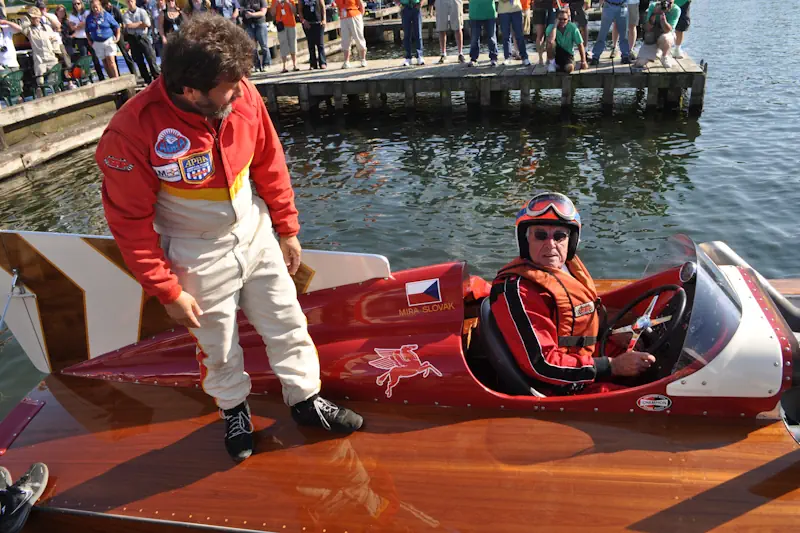
I will never forget that this museum allowed me to drive 24 different boats. The oldest type was the replica Miss Detroit III, the 1918 and 1919 Gold Cup winner, a classic Chris Smith single-step hull with an early aeroplane-derived Curtiss V-12. Then the Adolph Apel breakthrough tail-dragger three-pointer Tempo VI. I’ve driven Slo-mo IV, Slo-mo V, both Thriftways, the Bardahls, Pay ‘n Pak, the “Blue Blaster,” the Griffon Bud. The most recent Unlimited I’ve driven is the turbine-powered U-9 for Mike Jones. That hull had won the Gold Cup once at that time, and later twice more driven by Corey Peabody.
I feel really blessed. I’ve never won an Unlimited race but, from a historical point of view, I’m the only person—I think—that has driven an Unlimited from each generation, from each key design evolution. I have the sort of human database to say how those boats are different through the history of the sport. It’s just been fascinating. I didn’t need to win or lose a race.
The museum is still kind of an unknown. One of your board members describes this as “the museum with a little ‘m.’”
It’s an uphill climb. Yes, it is. The sport itself is contracting. There are people of our generation who came through one part or another of its golden era. New fans in the turbine era are not as enamored with the minutia of history. They may remember there’s a Thriftway. They don’t care whether it was the ‘55 or ‘57 or the ‘58 boat with the tall tail fin or the ‘59 boat with the short tail fin. They just know that a guy named Bill Muncey drove for Thriftway supermarket.
HARM has been more than a mistress for 32 years. I have put in my heart, my soul, but it’s killing me in terms of the anxiety, the constant chasing of money. There was a TV commercial for a furnace company: It showed a guy shoveling cash into a basement furnace. Is that old furnace burning your money? That’s my life. I told you, I raised and spent $13 million. From never really having more than three Unlimiteds we are running nine of them. I’ve got Allison and Merlin and Griffon engines. It is a constant, constant search for money. It has kept me up at night because I love it so much. Every boat on the floor I’ve touched, worked on, driven.
Have you been in therapy?
I haven’t, but I need to be. I came into this business when my father died, and realized, you should do what you want with your life, because it really is short. Well, I’m now at the age where my father was when he died, and I’m able to go to my third act and say, all right, I’ve done that. Now it’s time. I’m in bonus time.
We’re turning it over to Brad Haskin. Brad was a friend of Bob Williams’s and used to go to Bob’s house because they were memorabilia collectors. Bob was the first executive director, Ken the second, I’m third, Brad is the fourth. He’s a former naval aviator, former Miss Budweiser crew member, worked with Ronnie Brown and John Rheinberger and those guys, so he “gets” the sport. He understands. He has seen it ebb and flow, breathe, almost die, all of the above at one time or another, because he’s been around here 20 years. He’s worked for the Museum of Flight. He’s an aviation historian and has written a lot about air racing. I’m trying to leave him the tools to continue fundraising. He may feel different about this than I do.
Curious minds want to know: Whatever are HARM’s assets?
We’re not-for-profit. We have money in the bank, we have a pretty nice money market account, we have boats, we have motors, we have tools, we have inventory, we have a roomy new building on nine acres in Arlington—gifted by antiques-forever enthusiasts Joe Fraunheim and Ike Kielgas. Joe’s daughter owned the property. Covered storage is extremely important for antique boat preservation. A cool two-story late-1800s wood barn is intended for events. We have assets of about $3 million.
What!?
Well, that’s not all cash assets. The balance sheet includes the tooling. We have eight or nine running Unlimited hydroplanes, though I don’t want to look at them as financial assets. We’ve invested in five running Merlin engines. You try and buy a Merlin engine. They are $300,000 apiece.
If you had to liquidate …
The cost basis does not accrue labor. I suppose if I paid for labor, the cost basis could be labor. But if I invest $100,000 in building a replica, say in Wahoo’s case, $275,000, that’s the value of the asset, that’s what the IRS would recognize as an asset. That’s what it’s worth. The money we’ve raised and spent restoring boats doesn’t just disappear. We change that from a cash asset to inventory, a physical asset.
How many boats does the museum own? Some of your floor is rental space, I assume.
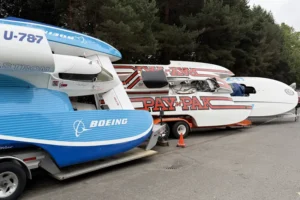
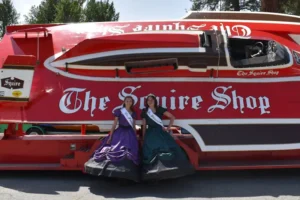
Bruce McCaw has two boats on display here. We own the Wahoo. We own Miss Burien, Pay ‘n Pak, the ‘77 and ‘82 Atlas, Miss Circus Circus, the Karelsen Budweiser, the Squire Shop. Eight boats, off the top of my head. We own Miss U, likely destined to hang from the ceiling. We own a bunch of limiteds. We own Valu-Mart/Weisfield’s/Olympia Beer plus the ‘68 Smirnoff bat-wing waiting to be restored. Each one of those boats has a $20,000 trailer, plus engines.
My conclusion is that your people essentially found happiness somewhere in there. They’re just drawn to these friggin’ machines that are totally useless except for speed.
Part of me wishes, you know, it would have been great if Miller and those others had kicked in a million each. We would have something different. I often refer to this as an outreach museum. I can’t get 100,000 people into our building, but I can take four or five boats among Tri-Cities, Seafair, and Mahogany and Merlot. That’s going to impact 100,000 people. But I’m not bringing the audience to the museum. I’m taking the museum out to the audience and that’s kind of the magic of what we’ve been able to accomplish, I guess.
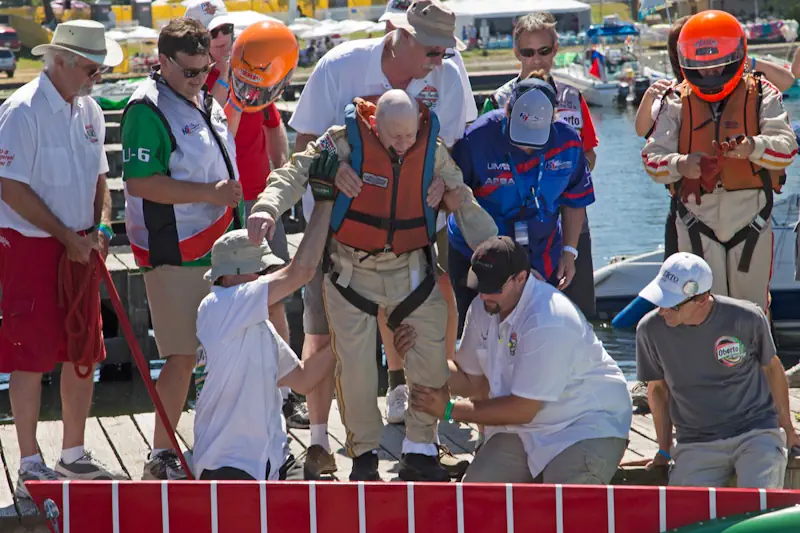
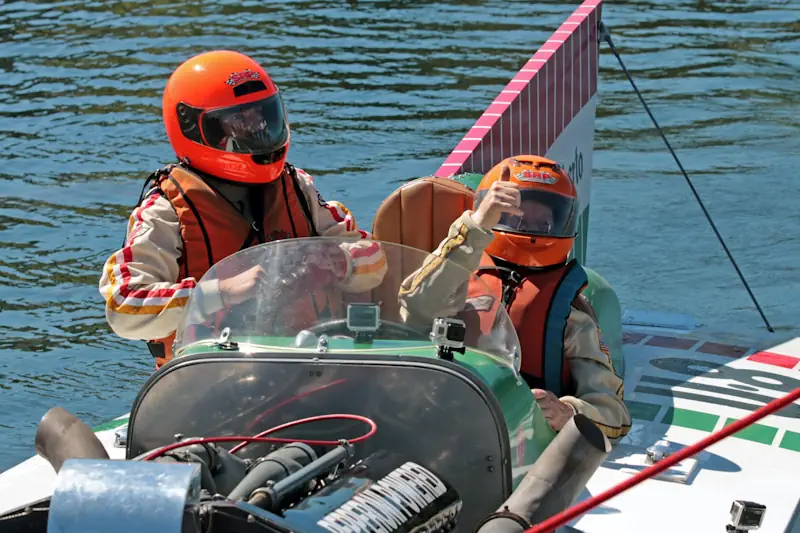
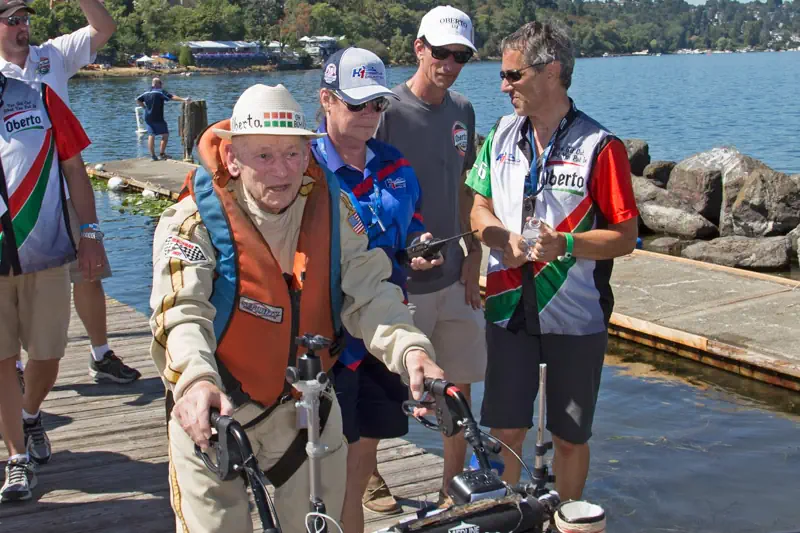
I must make a confession: I once killed Art Oberto.
You what?
I killed Art Oberto.
You’re the guy.
I’m the guy. Art Oberto’s family thought it would be cool for me to take him for an 85 mph ride in Oh Boy! Oberto on his 85th birthday. He’s frail with a walker. I’ve got two big guys who put Art into the boat as I get in. He’s got his helmet on, and he looks like a cartoon character because the helmet is so big and he’s kind of hunched. Just before I go, his son Jimi Oberto leans down and says, “Dave, you can kill him, but do not hurt him. Understand that if he dies, he dies, but don’t bring him back crippled”.
I said, “All right, gee, thanks.” He wanted to go past his house where Bill Cantrell rode Gale IV into that rose garden in 1954.
Out of the pits, we get through the first turn. Thumbs up. Heading down the backstretch the boat feels comfortable at 80. We have thumbs up at 90, thumbs up at 100. He wants to go fast. I accelerated to about 125. Nothing. I look over at Art, his mouth is open, tongue out, eyes closed, he’s leaning sideways. Oh my God, he’s had a heart attack! We have the TV helicopter overhead, fans on the shore, reporters aplenty. Do you know the philosophical conundrum Schrodinger’s Cat in the Box? As long as you don’t open the box, you don’t know if the cat is alive or dead.
You are about to be a man who lives in infamy.
As long as I don’t stop, Art is still alive. But I think he’s dead. What do I do? At about three-quarters of a lap, I see the URC rescue sled. They could bring him back with a defibrillator! I begin to slow down. Then out of the corner of my eye, I see this little hand with a thumbs-up. We did two more laps and I brought him in. Ken Muscatel explained afterward that it’s not terribly uncommon for a geriatric patient to have a sudden rush of adrenaline and pass out.
You escaped an everlasting memorable moment in hydroplane history. Slo-mo V looped. Bill Muncey hit the Coast Guard cutter. Remember when David Williams killed Art Oberto?
Almost.