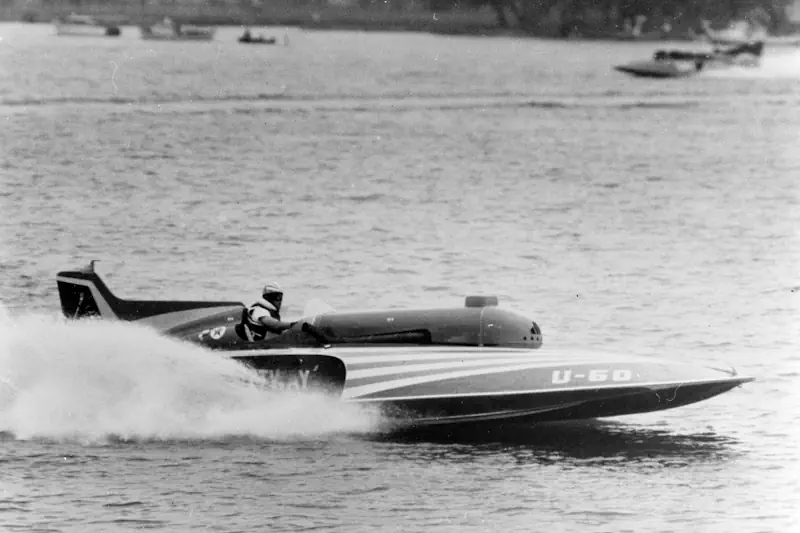
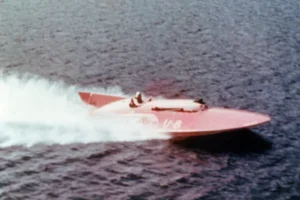
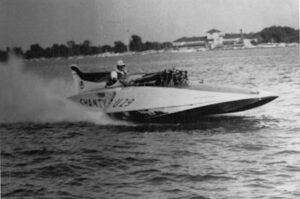
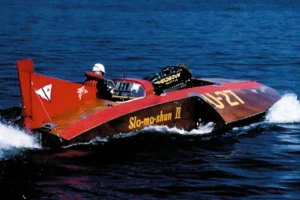
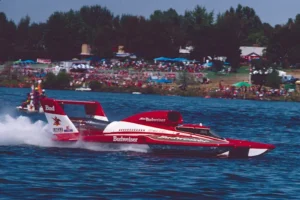
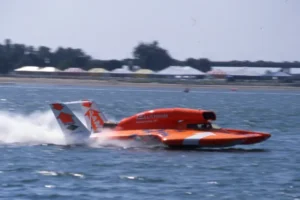
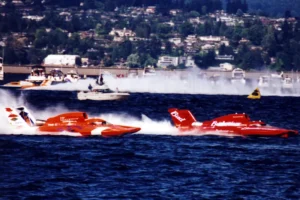
Bill Muncey leads a heat during the 1957 APBA Gold Cup held on Lake Washington in Seattle, Washington. (Source: Hydroplane & Raceboat Museum)
By Fred Farley – Unlimited Hydroplane Historian
In 1957, a total of twenty Unlimited hydroplanes set up shop in the– at the time–brand new Stan Sayres Memorial Pit Area in Seattle. The race was for the Gold Cup. This compared to the all-time post-World War II attendance record of twenty-two that showed up for the 1948 Gold Cup in Detroit.
The winner at Seattle in 1957 was Bill Muncey in the original Ted Jones-designed MISS THRIFTWAY, which represented the Seattle Yacht Club.
MISS THRIFTWAY’s 90-mile average of 101.979 was the first in Gold Cup history at over 100 miles per hour.
Muncey didn’t have the fastest boat there, but he had the most reliable.
Both HAWAII KAI III with Jack Regas and MISS WAHOO with Mira Slovak posted faster heat speeds than MISS THRIFTWAY. But neither the KAI nor the WAHOO were able to complete the 90-mile distance.
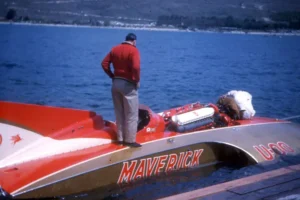
MAVERICK (former REBEL SUH) with Bill Stead also ran a faster heat (in Heat 1-C) than Muncey and managed to finish all three heats, but was slowed by mechanical difficulties in Heat 2-B and dropped from contention.
The fastest heat of the race was 109.823 (in Heat 1-C) by HAWAII KAI III; the fastest competition lap was 113.804 (in Heat 1-A) by MISS WAHOO.
MISS THRIFTWAY won Heat 1-B quite handily over a distant-running Russ Schleeh in SHANTY I. In Heat 2-A, MISS THRIFTWAY likewise finished considerably ahead of Chuck Thompson in SHORT CIRCUIT. Muncey’s heat speeds in 1-B and 2-A were an identical 104.016 miles per hour.
For the Final Heat, MISS THRIFTWAY had a considerable lead both in points and in total elapsed time. Muncey settled for a safe second behind MAVERICK. This gave MISS THRIFTWAY a total of 1500 points (including 400 Bonus Points for the fastest race), compared to 925 for SHANTY I and 869 for MAVERICK.
Of the twenty Unlimiteds in attendance, fifteen of these qualified at above the minimum speed of 95 miles per hour for three consecutive and continuously run laps around the 3-mile course. MAVERICK was the fastest qualifier with an average of 117.054.
The Detroit delegation in 1957 comprised GALE V, GALE VI, MISS U.S. I, MISS U.S. IV, SUCH CRUST III, and SHORT CIRCUIT (former TEMPO VII). Only one (SHORT CIRCUIT) qualified for the Final Heat and finished an overall fifth. And only one (MISS U.S. I with Fred Alter) averaged a heat at over 100 miles per hour.
The 1957 season marked the first appearance of a MISS BARDAHL hydroplane. This particular hull (the homebuilt former TEMPEST of 1956) was only sponsored–not owned–by Ole Bardahl. But with Norm Evans driving, the original “Green Dragon” got out in front in Heat 1- A of the Gold Cup and led Slovak in MISS WAHOO for several laps–a definite sign of things to come.
The originators of the Gold Cup series envisioned it as a development category with the door always open to new ideas. The 1957 contingent indeed featured a number of forward-thinking concepts–some more successful than others.
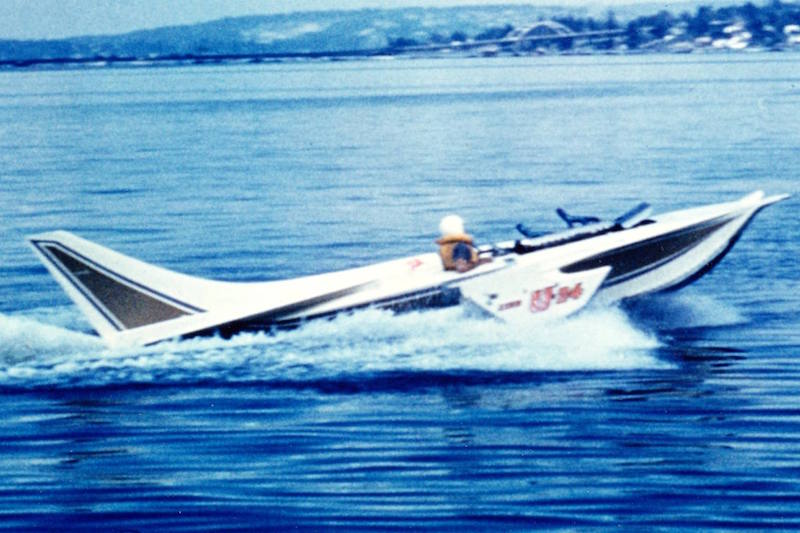
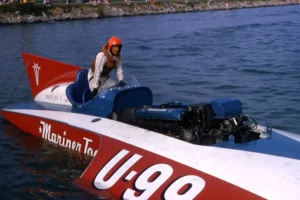
(Source: Hydroplane & Raceboat Museum) Armand Swenson aboard his uniquely designed Miss University District attempts to qualify for the 1957 Gold Cup.
The one-of-a-kind MISS “U” (also known as “Miss University District”) featured a one-point hull configuration and a Ranger 6-cylinder aircraft engine. Despite the efforts of owner Armand Swenson, a Seattle gunsmith, MISS “U” never achieved a planing attitude.
Wally Pannebaker’s WHIZSKI was a 7-Litre Class hydroplane that tried to pass itself off as an Unlimited. Measuring only 20 feet 10 inches in length, a 4-foot 2-inch tailfin was added to bring the boat up to the Unlimited minimum. Powered by a Packard automotive engine, WHIZSKI failed to achieve the qualification minimum of 95 miles per hour.
George Simon’s MISS U.S. IV, one of only three Unlimited hydroplanes ever designed by the distinguished Limited architect Henry Lauterbach, was an enlarged duplicate of Bob Rowland’s YOU ALL, a successful 266 Cubic Inch Class Lauterbach hull. Unfortunately, MISS U.S. IV never went any faster than a 266. She would top out at 120 miles per hour on the straightaway, and that was it.
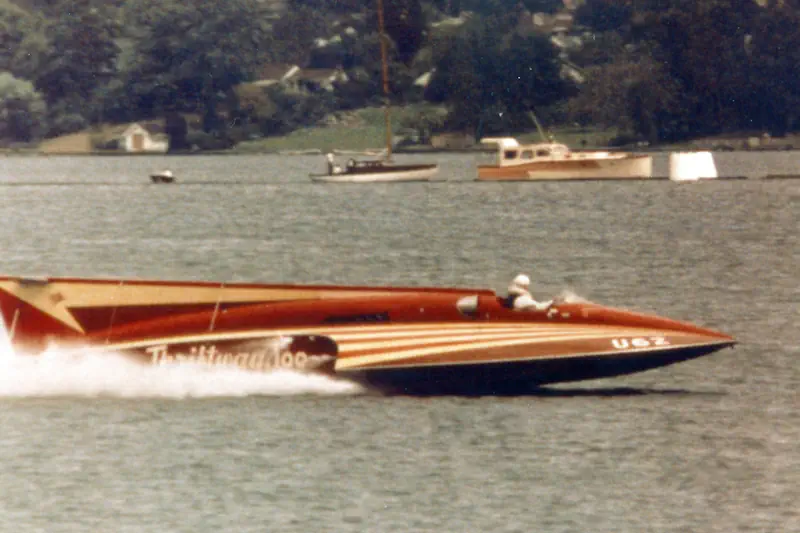
A lot of attention focused on THRIFTWAY TOO in 1957. Unlike every other boat on the circuit that year, THRIFTWAY TOO sported a forward- cockpit (or “cabover”) hull configuration. Since the end of World War II, a number of Unlimited hydroplanes had seated the driver ahead of the engine. These included SANT AMBROGIO (1948), SKIP-A-LONG (1948- 49), THUNDERBOLT (1952), and SCOOTER (1954).
The cabover Miss Thriftway Too was a radical new design concept by Ted Jones to seat the driver in front of the engine.(Photo: Bugeja)
Although touted by designer Ted Jones as “the boat of the future,” THRIFTWAY TOO was only sporadically competitive. She did manage to finish second in the 1957 President’s Cup and 1958 Diamond Cup races with Brien Wygle driving. The 34-foot hull was handicapped on account of being designed to carry two V-12 aircraft engines. But she never used more than one. And while her sister ship, the MISS THRIFTWAY, had a professional crew, THRIFTWAY TOO only had a volunteer crew.
After four years of experimentation, THRIFTWAY TOO–the first modern cabover–was written off as a failure and eventually buried in a landfill. But she left behind the germ of an idea that was later picked up upon and perfected by others.