
1959 Gold Cup Remembered
By Fred Farley – Unlimited Hydroplane Historian
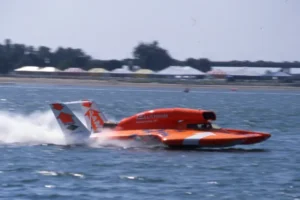
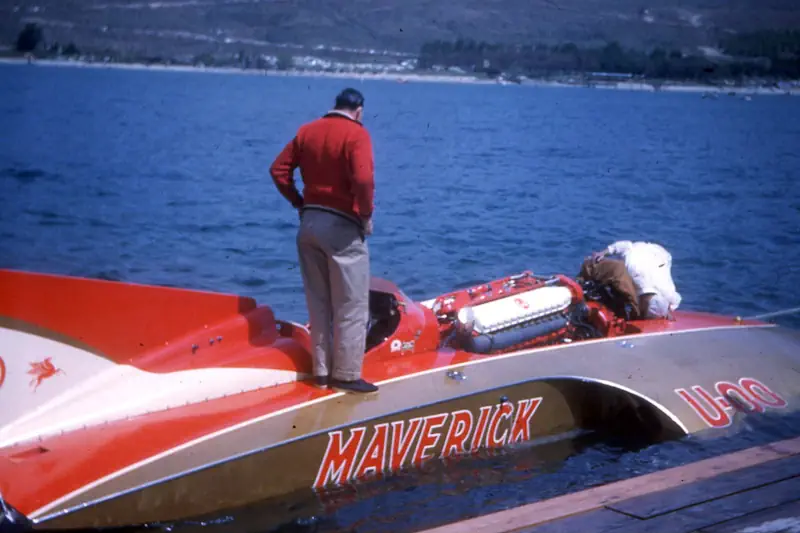
For the second time since 1955, the Seattle Yacht Club lost the Gold Cup to an out-of-town challenger. The winner in 1959 was the new Ted Jones-designed MAVERICK, a representative of the Lake Mead Yacht Club of Las Vegas, Nevada.
Race day, August 9, 1959, went down in history for being as keenly competitive as it was controversial.
The late fifties signaled a last stand–a glorious one–for the amateur sportsman tradition of racing. These were the days when boats with nicknames were more popular than those with commercial titles. And the Gold Cup’s location was still determined by the yacht club of the winning boat, thereby giving the local fans a personal stake in the race’s outcome.
The Seattle Yacht Club had won the Gold Cup in eight of the previous nine years. The 1959 SYC defense team comprised the MISS THRIFTWAY, THRIFTWAY TOO, WAHOO, MISS PAY ‘n SAVE, and MISS SEATTLE. All except MISS PAY ‘n SAVE–a Les Staudacher hull–were designed by Ted Jones.
The Seattle-based MISS BARDAHL was conspicuously absent from the starting line-up. Owner Ole Bardahl had temporarily retired from racing. This was in the wake of an accident two weeks earlier at Coeur d’Alene, Idaho, which left driver Jack Regas in critical condition. Regas had transferred to the “Green Dragon” team following the retirement of Edgar Kaiser.
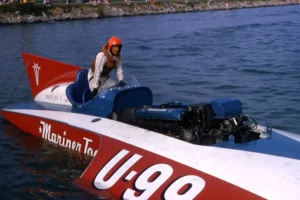
MISS THRIFTWAY was the third craft to carry that name since 1955, a replacement for the MISS THRIFTWAY that hit the Coast Guard boat in 1958. Like her predecessors, the 1959 MISS THRIFTWAY was designed by Jones but was built by her crew, headed by crew chief Jack Ramsay. The new boat was fast from the outset but rode very erratically during her first season.
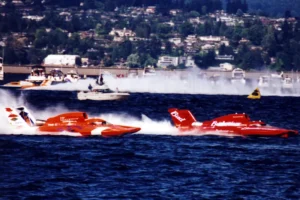
Drawn into Heat 1-A, MISS THRIFTWAY had to contend with the likes of MAVERICK, WAHOO, MISS SPOKANE, and NITROGEN. The THRIFTWAY started up, entered the course, and seemed to be running well. Then the photo recorder, a device for observing engine performance, exploded. Almost instantly, Muncey found himself wrapped up in yards and yards of photographic recording tape. This interfered with his concentration and cost him precious seconds in the moments just prior to the start.
Bill managed to salvage a third-place finish behind WAHOO and MAVERICK. But he was already at a disadvantage in respect to total elapsed time. Clearly, Muncey and MISS THRIFTWAY had their work cut out for them in the remaining 60 miles of racing.
Unlike 1-A, Heat 2-A went according to plan with THRIFTWAY winning it decisively over MISS SPOKANE. Heat 2-B went to MAVERICK’s Bill Stead who turned in the day’s fastest 30-mile heat at 106.287, compared to Muncey’s 105.820 speed in 2-A. Although nearly equal in accumulated points, MAVERICK possessed a considerable elapsed time edge over MISS THRIFTWAY at the outset of Heat Three.
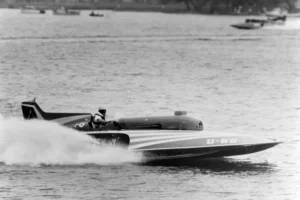
In the final showdown, Muncey and Stead ran close together with Muncey ahead and Stead electing to run conservatively, being content to maintain his elapsed time edge for all three heats combined. Then, abruptly, MAVERICK spun out in the lower turn and missed a buoy.
Stead circled back to correct his error while MISS THRIFTWAY rocketed away and moved up on the front-running Mira Slovak in WAHOO. Slovak, not having scored in the Second Heat, had no chance of winning and “opened the door” for Muncey, voluntarily relinquishing the lead to his fellow SYC defender.
MISS THRIFTWAY took the checkered flag with WAHOO close behind. MISS SPOKANE followed and MAVERICK crossed the finish line in fourth. Stead still had an 8.3-second advantage over THRIFTWAY for the 90 miles, but had fallen behind Muncey on total points, 1269 to 1325.
The Seattle Yacht Club team’s strategy had apparently worked. Bill Muncey and MISS THRIFTWAY had seemingly done it again for the third time in five years of Gold Cup participation.
But this was not to be.

Third-place MISS SPOKANE, it was later determined, had jumped the gun and had to be assessed a one-lap penalty. This dropped the Norm Evans-chauffeured craft to fifth and moved Bill Stead from fourth-place to third.
In the corrected order of finish, MAVERICK and MISS THRIFTWAY ended in a tie in points, which paved the way for a replay of their 1959 Diamond Cup scenario. In both instances, Muncey had outrun his rival from Las Vegas in the Final Heat only to lose the overall race on total elapsed time. This was before the days when the winner of the Final Heat was automatically the winner of the race in an Unlimited event.
MISS SPOKANE’s blunder cost Seattle the Gold Cup, which was whisked off to Lake Mead, Nevada, for 1960.
A jubilant Bill Stead proclaimed, “I can’t thank Norm Evans enough!”
Ironically, MAVERICK owner Bill Waggoner had represented Seattle during 1956 and 1957 but had a falling-out with the SYC over custody of the Harmsworth Trophy. Waggoner then transferred his affiliation to the Lake Mead Yacht Club for 1958 and 1959.
A third Muncey victory in the Gold Cup would have to wait for another day in another season. The 1959 event marked the second time that Bill had physically won the big race out on the race course but had been prevented from taking the trophy home because of the official fine print.
A case could undeniably be made that the 1955 Gold Cup loss was brought about by Muncey’s own inexcusable ignorance of the rules regarding Bonus Points and total elapsed time–but not so in 1959 when he did everything according to Hoyle.
As it was, Norm Evans made a mistake. But it was Muncey, the Seattle Yacht Club, and the entire Pacific Northwest that wound up having to pay for it–with the Gold Cup.