
Steve Reynolds - "My Rookie Year"
By Fred Farley – Unlimited Hydroplane Historian
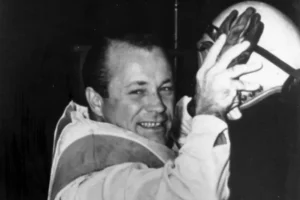
(EDITOR’S NOTE: There was a bright new star on the Unlimited hydroplane horizon in 1979: Kirkland, Washington rookie Steve Reynolds, pilot of the casino-backed MISS CIRCUS CIRCUS from Reno and Las Vegas.
Having completed his first full season with the world’s most spectacular racing boats, the Seattle-born Reynolds shaped up as the most exciting new talent to occupy a Thunderboat cockpit in many a moon.
Thirteen months following his first test ride in an Unlimited, Reynolds, age 32, had command of second-place in a field of twenty drivers in accumulated season points. He had qualified fastest at four out of nine U-boat events, set a world record with a 2.5-mile lap speed of 133.136 miles per hour at the Tri-Cities Columbia Cup, was the Unlimited Class Rookie-of-the-Year, and the proud owner of the Jack-In-The-Box Thunderboat Regatta first-place trophy for a winning performance on San Diego’s Mission Bay.
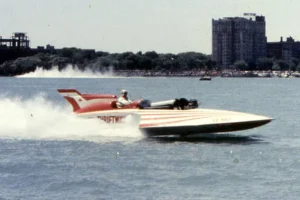
A former U.S. Marine helicopter crew chief and gunner during the Vietnam War, Reynolds posted a 1979 competition box score of 24 heats started, 21 finished, nine in first-place, six in second, five in third, and one in fourth, piloting the pink-and-white-colored U-31. In addition to the San Diego victory, Reynolds took second-place in the nationally televised APBA Gold Cup Regatta on the Ohio River in Madison, Indiana.
The following is based upon an interview that I conducted with Steve in the Fall of 1979.)
When the Circus Circus organization first entered Unlimited competition in September 1978, they didn’t want to put just any operation down the road. They wanted a winning operation, and one that looked nice. The owners, Mr. William G. Bennett and Mr. William N. Pennington, put together as much talent that is available in the field. This included Design Engineer Dave Knowlen and Crew Chief Jim Harvey, whose records speak for them.
We had our backs up against the wall as we prepared for 1979, knowing that we had to do in six months what ordinarily takes a year. Our work was plainly cut out for us. Not since 1966 had a new team with a new boat and a new driver been able to win an Unlimited race in its first season. But this was the kind of challenge that brought out the best in Jim Harvey–the one veteran in the group–in his first assignment as a crew chief. (Jim had previously been associated with MISS BUDWEISER, NOTRE DAME, VALU-MART, and MISS TIMEX, among others.)
We really had to dig the Rolls-Royce Merlins out of the woodwork. Some of the engines that we acquired came from all corners of the Earth–in South America, Australia, New Zealand, India, and Europe. Merlins are hard to find these days, but they’re still out there. The money invested is substantial where Merlins are concerned because of the shipping costs. So the market value is quite high. They’re not $150 surplus engines gathering dust on the end of an airfield in Indianapolis or Los Angeles anymore.
On September 17, 1978, we took third-place at San Diego with the original MISS CIRCUS CIRCUS, which had run in 1977 as Bernie Little’s ANHEUSER-BUSCH NATURAL LIGHT. The team was less than three weeks old. It was my first race of any kind since an accident with my world record-holding 225 Class rig in May of that year. We were happy with our initial performance, although that was to be the first and last time that we would ever be satisfied with anything less than first-place.
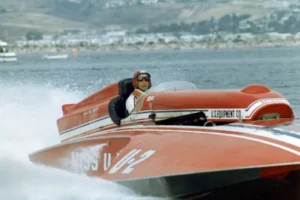
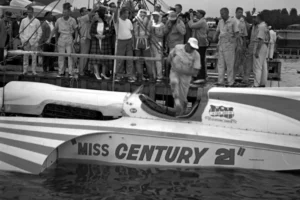
We launched the new MISS CIRCUS CIRCUS on April 26, 1979, on Lake Washington in Seattle. Christened by Nevada Governor Robert List, the craft measured 29 feet by 13 feet 10 inches and tipped the scales at just over 6,000 pounds. Norm Berg, who also built by 225, did a fantastic job.
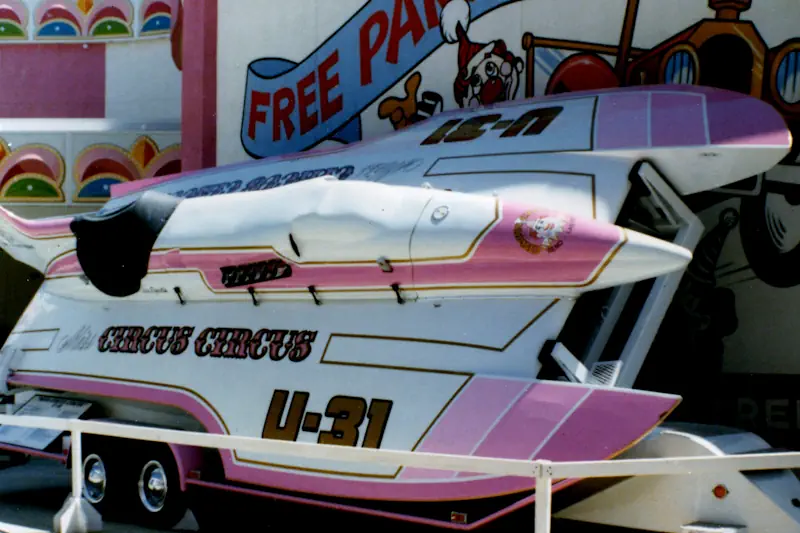
As a youngster, I was always a fan of the famed “Pink Lady” HAWAII KAI III, winner of the 1958 Gold Cup Race in Seattle with Jack Regas driving. We painted our boat pink as well–three shades of it–on white with gold and black trim.
At the christening ceremony, my wife Linda had our baby daughter Krista decked out in a new pink jumpsuit, embroidered with the logo “Pink Team”.
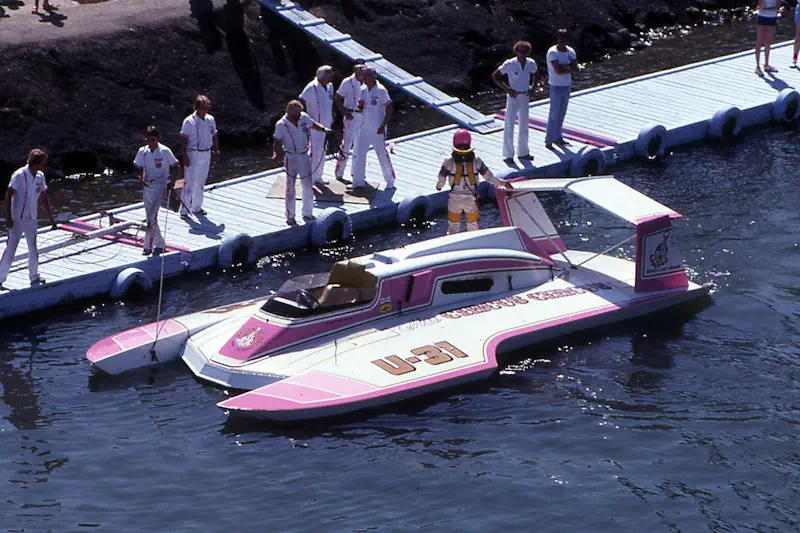
With the first race of the season in Miami less than seven weeks away, we tested in earnest. Of course, we received a lot of encouragement from Mr. Bennett and Mr. Pennington who didn’t enter the program to field another “also-ran”.
Myself, I was still very much in awe of the size and power that an Unlimited hydroplane has. I wished that we had had about a month more of testing. So, heading into Miami, I was apprehensive. I really didn’t know what the boat was going to do at top speed with other boats running with it. But I was really looking forward to the challenge.
In Miami, we had a violent hooking problem. I couldn’t turn the boat very sharp, although I tried a number of different ways. I think we logged more testing time than anybody else down there. Going into the race, we were still very nervous about the hooking. I was anyway. We were running too high a gear ratio, although we did manage to qualify fastest at 120.000 around the 2.5-mile course and at 110.092–a record–on the 1.67-mile course.
We took second-place overall behind Bill Muncey and the ATLAS VAN LINES, and I won my first heat there in Section 2-A. As I look back on the experience, several things needed to be established right off the bat: Number one, that the MISS CIRCUS CIRCUS was going to be a contender all year long; and number two, I wanted to gain the respect, as a driver, of the other drivers. I made three very good starts at Miami, and we actually led at one time or another in each heat. So we were pleased.
Then, it was on to Evansville, Indiana. There was considerable pressure on me. I knew that the boat had lots of capability, but it was me who was getting beaten by Bill Muncey.
We didn’t finish the first time out at Evansville, when the Nitrous Oxide valve stuck open, and I couldn’t decelerate the boat. Prior to the Second Heat, I decided that I would have to get Muncey out of position. So I tried to keep him “on my hip” all the way around the corner, coming around for the start. I kept him there until he began to slide to the inside of me. When I saw that, I moved over to lane-one, and I was on my way to the checkered flag. I thought it was a pretty good move, because it certainly paid off for us. We averaged 111.975 to Muncey’s 111.317 for five laps around the 2-mile Ohio River course.
We finished an overall second to the ATLAS at Evansville, but not without a near-collision with Muncey on the upper turn of the first lap in Heat Three. He was running just ahead of me on the outside. I don’t believe Bill did anything intentionally, but he didn’t know that I was there. He really didn’t.
I watched the back of his helmet all the way down the back chute. And as I was picking up on him, I was saying, “God, Bill, will you please turn around and look and see that I’m here?” And it came to that moment of decision: Do I back out of it and go through his roostertail, or do I stay in it and hope that he leaves me enough room. And, in that second of indecision, I was already committed. I turned the boat as hard as I could and went right up over the top of his skidfin. The boat went over his cowlings. The guys in the pits thought that the boat was gone. I just ducked my head down and waited for the crunch.
I’m surprised that it came down right-side up and kept on going. I talked to Bill about it later. It was an interesting conversation.
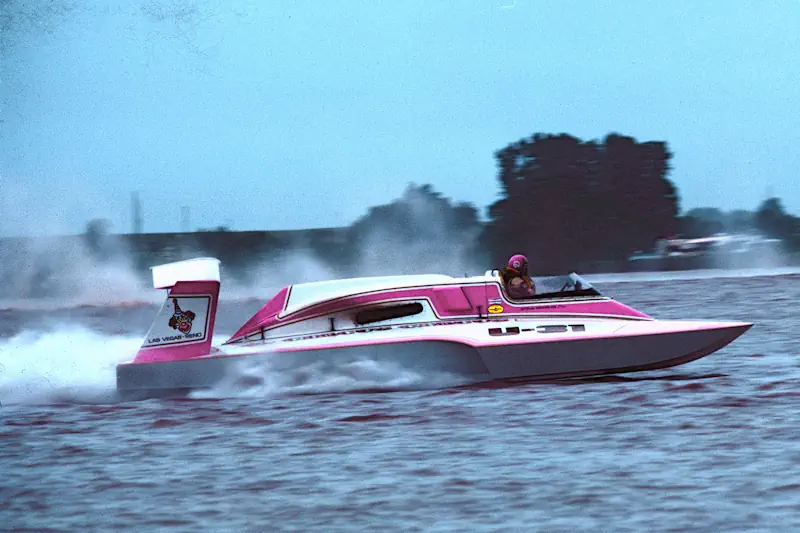
At Detroit, we had our first major problem where propellers were concerned. Throughout the year, MISS CIRCUS CIRCUS had an extraordinarily good record with engines. We didn’t lose any due to engine failure per se. We did scatter a couple of them as a result of losing the propeller and the power plant over-speeding. Jim Harvey and I worked on and had a lot of conversations about engines. You don’t just drive these boats. You have to drive those motors as well.
I really had to learn everything that I could about driving the engines. So I would constantly monitor the manifold pressure, finding out where I could apply power and where I couldn’t. Generally, I was just trying to mature as a driver.
After each race, late Sunday night, I would sit down and run the race over in my mind. Then, I’d write it down and criticize myself, finding out what I did wrong or what I didn’t do or where others did better than I. This was my way of trying to improve. I had to acquire an awful lot of maturity in a hurry. And I worked very hard at it.
Detroit was a very significant race for me as far as progressing through the season. That was the first time when I had tried as hard as I could and someone else–Bill Muncey–had done it better than I did. It was hard for me to handle.
I had a near-miss with a wall as I came out of the “Roostertail Turn” on the first lap of the race. I don’t blame Muncey for the incident at all. He gave me plenty of room. Overdriving was what it was.
As we prepared for the Second Heat, the crew was saying, “We’ve got to start on the inside or we’re not going to beat the ATLAS.” So Mr. Bennett talked with me about it. I told him that I wasn’t comfortable driving on the inside and that I didn’t want to drive there until I was more at ease. I felt, and still feel, that a driver can control a race from the outside in lane-two or lane-three. And, as rough as the conditions were in Detroit, I felt that the outside was the ideal place for me to be. So Mr. Bennett said, “Well, just go out and drive your own race.” Then, I said to myself, “Damn it, I’m going to start in lane-one anyway!”
During the Second Heat warm-up period, Bill took the inside away from me going down the back chute. So I just pulled a Muncey on him. I hid right in his blind spot, where he couldn’t see me. And, just at the time that we entered the corner, I cut across the transom of his boat, tucked right along side of him, looked him right in the face, and said, “Hey! Here I am!”
When he sped up, I would speed up; when he slowed down, I would slow down. I just would not let him get on the inside and ahead of me. When we started to set up on the buoy, I went about two lanes deeper into the corner. So he had to correct to the right. And the moment that I saw him turn his hands to the right, I turned to the left and picked up about three boat lengths on him.
I had, I thought, a pretty good lead when I came out of the corner, but then the boat stopped dead in the water. I figured that we had just lost the front end when in fact the propeller had let go. The blower had really scattered. There was no gear box, no prop shaft, and about a seven-foot hole in the bottom.
Back in the pits, there didn’t seem to be any way that we could be ready for the Gold Cup Race the following week in Madison, Indiana. But Mr. Bennett came up and put his arm around me and said, “If it’s possible, we’ll put it back together.”
I had challenged Muncey and beaten him. Bill may have won the Spirit Of Detroit Trophy, but a driver is only the best from week to week. And I let Muncey know that I would keep coming at him until it was me who would win the first-place trophy.
So Detroit was a very maturing race for me. And Mr. Bennett recognized that fact. My safety is uppermost in his mind. And I appreciate that. He never puts pressure on me. When he thinks that I should be driving in a different way, it’s more of a suggestion than an order. He leaves the final decision to me. And, as we walked away together, he looked at me and said, “You needed that one, didn’t you?” And I replied, “Yeah, I did.”
And that was the truth.
The 1979 Gold Cup at Madison was quite a race. As a driver, I was picking up more experience as I went along. We made some modifications to the boat. And I thought it was running better. However, it was still getting dangerously loose at about 155 miles per hour. The faster I went, the higher MISS CIRCUS CIRCUS flew out of the water.
We won our three elimination heats at Madison and managed to beat the ATLAS again in Section 2-B, setting a course record of 113.636 for the 15-mile distance. A couple of new boats made their debut that day over the Fourth of July weekend. These were Bernie Little’s MISS BUDWEISER, powered by a Rolls-Griffon, and Bob Steil’s THE SQUIRE SHOP, which was a hull copy of our own boat, also designed by Dave Knowlen.
Going into the Championship Heat, the Ohio River was rough, but–judging by the competition of the day–I was optimistic. As I led into the first turn, I thought to myself, “You dumb rookie, you’re going to pull off a Gold Cup!” I really thought I had the race won, but then I hit a turbulent stretch, and my boat did everything but flip. I saw that well known “blue blur”–the ATLAS VAN LINES–roar past me and Bill Muncey was on his way to the bank once again.
We took second ahead of Chip Hanauer in THE SQUIRE SHOP, Bob Maschmedt in DR. TOYOTA, and Jack Schafer, Jr., in TRI-CITY TILE & MASONRY. I was quite disappointed, but my crew gave me a round of applause when I returned to the dock.
In an attempt to calm the boat down for the next race in El Dorado, Kansas, Dave Knowlen designed a spoiler. It helped a great deal, and we were definitely the favorite at that race, qualifying fastest at 126.316 around the 2-mile course on Lake Bluestem. Bill Muncey, who is great at pre-race psychology, went out all week and tried very hard to run as fast and corner as well as we did, but he still couldn’t match us. On television, Bill questioned my strategy of running fast so early in the week. I replied that I wanted to give him a performance that would really make him work for it. And that’s exactly what I did.
During the qualification period, we broke two skid fins. Nothing that I can think of–and this includes my Vietnam experience–worries me more than going into a turn at 165 miles an hour and losing a fin. This happened at El Dorado. I have no idea how I stayed with the boat. It rolled up on its right side two or three times before it swapped ends and stopped. I was only hanging on by one hand. My right hand was on the wheel, and my left foot was up in the air. I had visions of Skipp Walther going out and being hit by the boat, and then having it run right over the top of me. I actually twisted the rubber right around the steering wheel, I held on so hard.
We won the first heat and took third in the second. However, in the Final, I didn’t use the Nitrous Oxide properly. It was all inexperience on my part. I didn’t have enough RPM on the engine, and I hit the Nitrous button too soon. When that happened, the Nitrous plus the fuel flooded the engine and the spark plugs fouled. At first we thought we might have a carburetion problem, but it was just a rookie mistake, and I learned the hard way. But that was the first race of the season where we had gone in as the favorite.
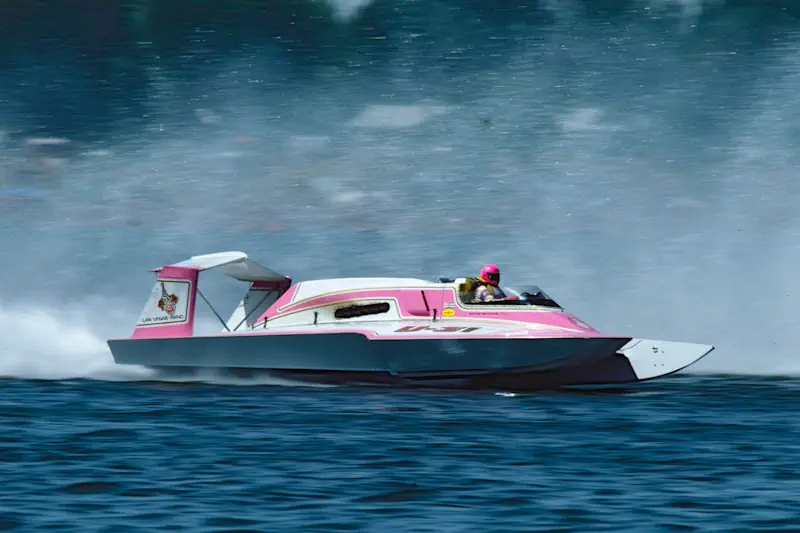
Moving out West to the Columbia Cup at the Tri-Cities, Washington, I felt truly comfortable with the boat for the first time.. There’s a certain union that a driver achieves with a boat before he’s able to drive it well. He feels in control.
The boat and I were communicating very well when we qualified at the fastest speed ever turned on a closed course: 133.136 miles an hour. We had damaged two engines that week because of induction temperature problems. When I went out for the record run, Jim Harvey told me, “If it feels good, go ahead and give it one or two really hard laps, but don’t break anything.”
They didn’t turn the Nitrous on for me, and we really didn’t intend to go that fast. I feathered the throttle at about 165. About half way down the chute, I’d hold it there and then decelerate. We could have gone a little faster, and I was shocked when I learned we had done that well.
Setting the record was exciting, and I felt good. That’s where the maturity was coming. And I think at that point the others were beginning to recognize CIRCUS CIRCUS as a contender and Steve Reynolds as a driver. That’s what I was aiming for.
On race day at the Tri-Cities, the competition caught up with the ATLAS VAN LINES, and Bill Muncey had to really work for the win–his sixth of the year. I had the impression that he couldn’t afford to sit back anymore, take the outside lane, and then dart or push himself into a good position going down to the start. From the Columbia Cup onward, he had to establish himself a lot earlier, or he was going to get beat. And I’m surprised that he didn’t change his strategy for the Western races. He did the same thing all year long. It proved successful in some cases, but I don’t think he can do that anymore.
It might have been hard for him to adapt. With boats such as the MISS BUDWEISER, THE SQUIRE SHOP, and the MISS CIRCUS CIRCUS out there, all capable of running with the ATLAS, it was a competitive situation that Muncey hadn’t been used to in three years.
We won our first Columbia Cup heat at 121.033 miles an hour. The next time out, we were trailing the BUDWEISER by a few seconds and leading the ATLAS when we broke another prop, which necessitated another rebuild job for the following race in Seattle, where we played a game.
All week long, we cried “propeller.” We went to great lengths to prove that we didn’t have a good prop. We put an old one on during qualifying that caused the boat to dive on its nose and wallow around. This made it look as though we really had prop problems. I almost blew the whole masquerade in the first heat, beating Dean Chenoweth in the MISS BUDWEISER. A TV interviewer asked, “Steve, your first lap was 119. Can you explain that?” I said, “Gee, I didn’t think the boat would go that fast.”
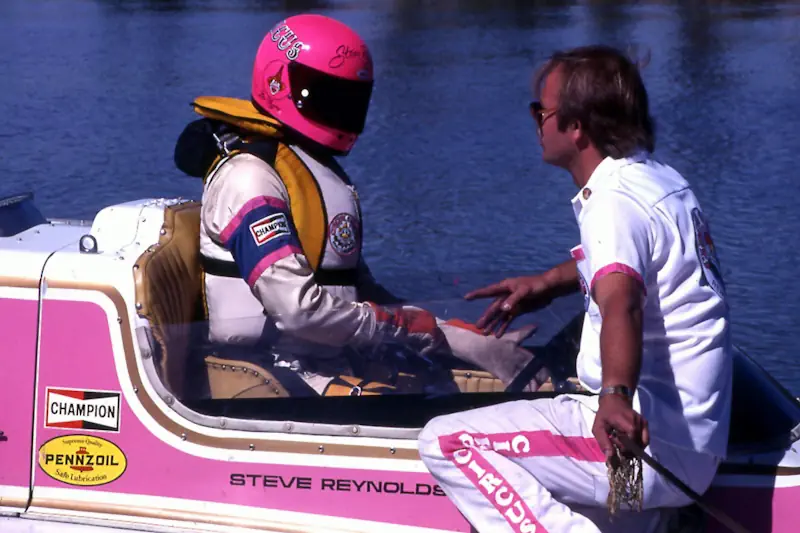
In the Final Heat, I thought I had the Seafair race won before the hometown crowd, until I realized that we had jumped the gun. I did so by less than a boat length, but that dropped us to an official fourth-place overall. I was terribly disappointed and angry, but I nevertheless stayed ahead of the field and didn’t let anyone pass me. It was a case of Steve Reynolds paying his dues. In the meantime, Muncey recovered from a bad start and eventually outran Chenoweth to win his third straight Seafair Trophy in as many years.
I’d just as soon forget the next race in Ogden, Utah, where we had nothing but trouble. I think we went out ten or eleven times during the week, but I couldn’t get the boat to run. And that’s frustrating to a driver.
We finally found the problem on the morning of the race, after going through four or five of the engines that we had brought down. We made one big mistake in that we took the spoiler off the front of the boat. We thought that the altitude would compensate for that, which it didn’t.
Our strategy at Ogden was to do the best we could to get into the Final Heat. At that time, the National Points race wasn’t totally locked up. So we wanted to finish well. But, at the same time, I had to be conscious of saving the equipment.
In Heat 1-A, we led the BUDWEISER for three laps, but the boat was really working the engine hard. So I slowed down and the BUDWEISER went by us. Then, in Heat 2-A, the propeller let go again and really caused a lot of damage. It didn’t look as bad as Detroit, but it was harder to fix. We broke both main engine stringers, a lot of frames and hardware–including the steering gear. We also bent the rudder and the transom blew out.
For the Final Heat at Ogden, I filled in as a guest commentator over the National Power Boat Network and watched THE SQUIRE SHOP’s Chip Hanauer end Bill Muncey’s win streak. The win was Chip’s first in Unlimiteds, while I was still in search of my first victory. The MISS CIRCUS CIRCUS team was now one year old. We had paid our share of dues, and we were hungry for a win in the worst way.
I’ve been asked if the reason I seek victory is for the thrill of winning or the fear of losing. After the 1979 race in San Diego, I can say that it’s DEFINITELY the thrill of winning…and win we did in the last race of the season on Mission Bay, where the team first appeared the year before.

Going into the Final Heat at San Diego, we gambled on an untried propeller. (The one that we had used previously was so small that it was throwing lots of water.) Jim Harvey was worried about blowing an engine, and Dave Knowlen didn’t know what the new prop would do. Mr. Bennett and Mr. Pennington wanted to go with the newer wheel. So the die was cast.
There was no question in my mind. At that point in the season, in my career, I had learned that I didn’t have to get it all in the first turn. Although it’s very hard for a driver to sit back in third or fourth-place, knowing that he has the power and having to pick and choose the time to use it.
Still, I had to measure the equipment, and I didn’t know exactly how fast we were going down the back chute. Dean Chenoweth told me after the race that he saw 180, and everybody was right with him. So we were really running fine.
Chip Hanauer set up a beautiful symmetrical arc going to the corner, and I just tucked in on his hip, set the wheel, and made the same arc that he did. If he had swung a little wide and then hooked it back in tight, he would have put me out a little farther. But, fortunately for me, he didn’t do that.
And then, the hot pace started taking its toll. The ATLAS dropped out and so did the BUDWEISER. Coming out of the first turn, the SQUIRE and the CIRCUS were side by side with ATLAS dead in the water in the middle of the course.
Chip wanted to slide wide, but I wouldn’t let him. So he had to turn to the left of the disabled “Blue Blaster”. Otherwise, he would have run right down the middle of Muncey’s boat. It was at that time that SQUIRE experienced some carburetor troubles. Chip backed off, looked over at me, and saw that I wasn’t going to let him out any further. I went into the lead and didn’t see him after that.
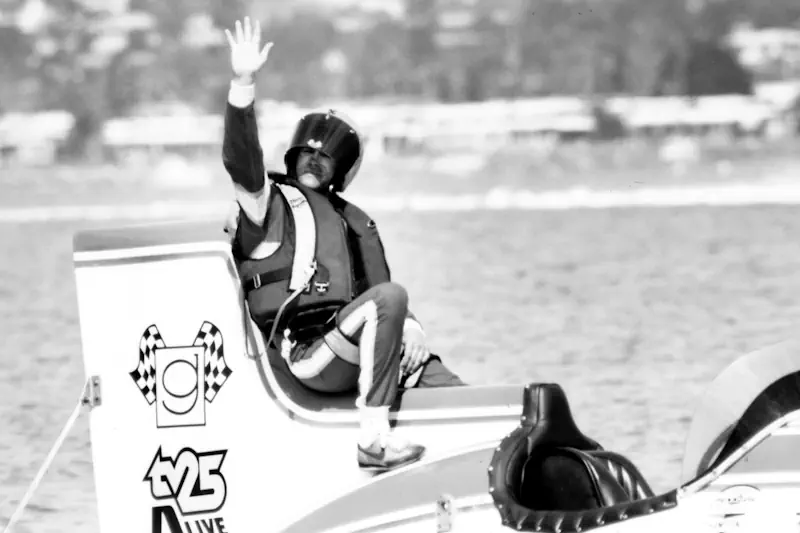
I really prefer to win a race by leading from wire to wire. Of course, as I’ve said before, the winner’s the winner, whether it be luck or whatever. And we came out on top. I’ve never been so excited in my life. I beat the hell out of the steering wheel, jumped up and down, and waved my arms while still going 150 miles an hour. It about sucked me out of the cockpit.
Returning to the pits, I felt like MacArthur coming back to the United States. The Navy Band was there, playing the theme from ROCKY. People were squirting champagne up in the air. I mean everybody was thrilled. That was just a tremendous day. And it was the greatest thing that happened to me all year.
Up until that point, I was just saying to myself, “My God, what’s going to break this time? What’s going to stop us from winning? What do I have to do to win one of these things?”
Now, after having one under my belt, winning one, I’ll never forget that feeling. That in itself is a tremendous incentive to go out there and try to win. It’s terrific. I love it.
Related Articles